
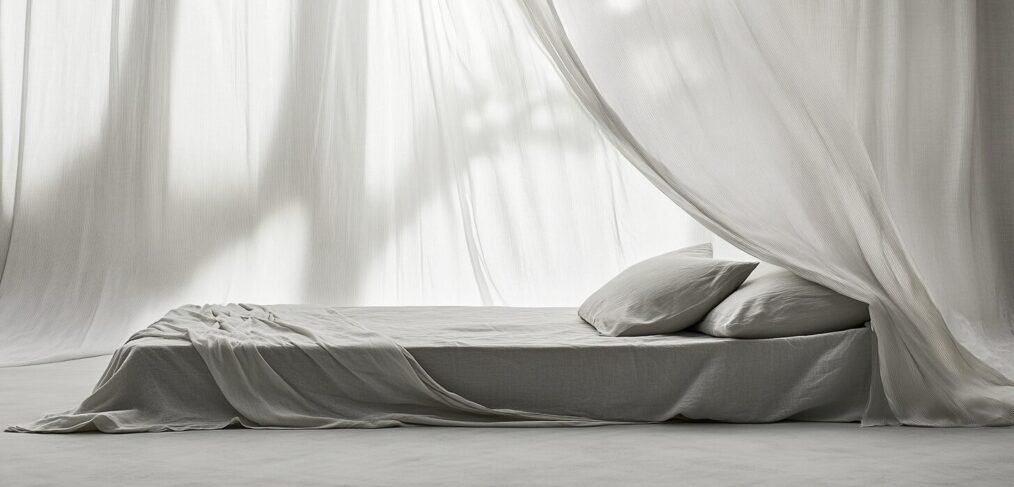
How Your Environment Affects Your Nervous System — and Your Sleep
You can walk into a room and feel your shoulders drop. You can walk into another and feel something in you brace. Neither response is imagination, and neither is a personality quirk. Your nervous system reads your surroundings continuously, light, order, texture, unfinished tasks in visual range, and it adjusts your internal state to match what it finds. Most people treat their environment as a backdrop to their life. Physiologically, it is closer to an instruction.
This matters for sleep more than almost anyone acknowledges, because the system that lets you sleep deeply is the same system that has been reading your rooms all day.
Your surroundings are an input, not a backdrop
The nervous system does not clock off when you stop working. It scans, constantly, for signals of safety or demand and your environment is one of its richest sources. To the scanning system, a pile of papers registers as unfinished work. A room in disorder presents dozens of competing visual signals, each one a small claim on attention. None of them is loud. Together they hold the system in a state of low-grade readiness — the same readiness that later shows up as a mind that will not switch off at 11pm.
This is why the feeling of walking into a freshly ordered room is so distinct. Nothing about you has changed. The input has changed, and your system has answered it.
What the research actually shows
One study is worth knowing here. In 2010, researchers Darby Saxbe and Rena Repetti published a study in Personality and Social Psychology Bulletin in which sixty dual-income couples gave recorded tours of their own homes. The language people used was analysed, words describing clutter and unfinished projects versus words describing rest and restoration. The women whose home descriptions leaned stressful and cluttered showed flatter daily cortisol slopes over the following days, a pattern associated with chronic stress and poorer health outcomes. The women who described their homes as restorative showed the steeper, healthier cortisol curves.
Two caveats. The study is correlational, it cannot prove the home caused the cortisol pattern. And the effect showed clearly in the women, far less in the men. But that second point is not a weakness of the finding. It is the finding. The person who carries responsibility for a space is the person whose physiology tracks the state of that space.
Why the capable ones feel it most
Here is the pattern I see in the people I work with. The more someone runs on responsibility, the more they are the one who holds things together at work and at home, the more their environment functions as a live to-do list. They do not see a garden; they see a task they have not done. They do not see a kitchen; they see the evening’s obligations. Every untended corner is an open loop, and an open loop is a demand the system keeps holding.
For that person, an ordered, beautiful space is one of the few inputs that tells their system, unambiguously, that nothing is being asked of it right now. That signal, nothing is being asked of you, is the precondition for deep sleep. No supplement supplies it.
A tended space is not a luxury. It is an input your nervous system reads.
Tending as regulation
Last week at Casa Anandi the heat had run ahead of me and the garden had gone untidy, weeds, long grass, the low disorder that accumulates when temperatures make work unappealing. I did the mowing and strimming as the sun went down, and cleaned the house the next day. What struck me was not satisfaction in the chore. It was the shift afterwards: more spacious, lighter, somehow stronger. The work of tending the space had done something the space then kept doing for me.
That is the reframe worth taking away. Tending your environment, done with attention, is recovery itself — a physical act that closes loops, and a changed input that keeps signalling safety long after you have stopped. And wanting a beautiful space is your system asking for one of the conditions it needs.
For a closer, bedroom-specific version of this, practical setup, not just theory — see The Sacred Space.
If your environment is ordered and your sleep is still broken, the pattern usually sits deeper — in the system itself, not the room. If this resonates, the Inner Stability Quiz is a good place to start — it takes five minutes and tells you what your system is actually doing. https://courses.thesleepguru.co.uk/inner-stability-quiz