
What a River in Rishikesh Taught Me About the Nervous System
And why the wired-but-tired nervous system pattern is really about flow, not force
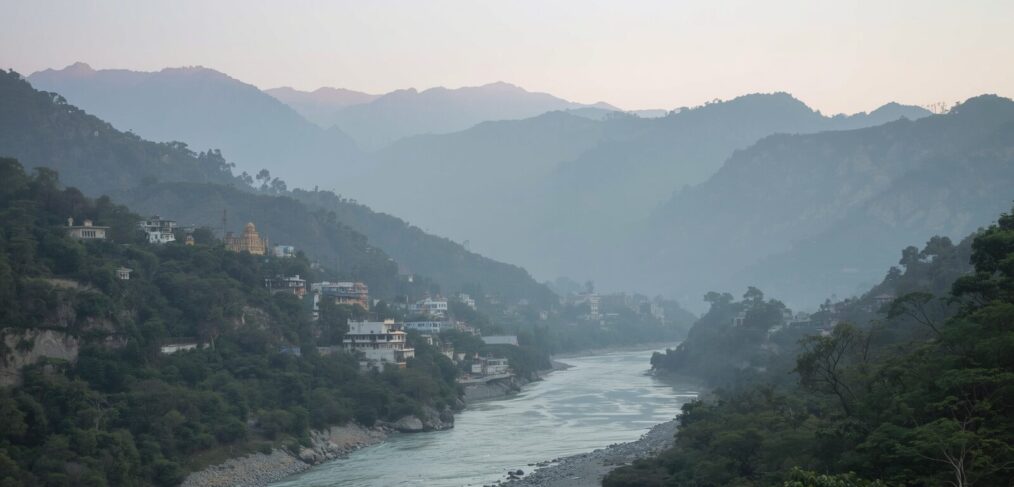
I’m writing this from an ashram in the jungle above Rishikesh.
My balcony is level with the treetops. Monkeys somewhere nearby. The river below, catching light, moving constantly. The air soft in a way that feels almost medicinal.
We’re practising yoga, Agni Hotra, breathwork, meditation. And I feel something I don’t often allow myself to feel in full: completely still.
Not tired. Not switched off. Still.
There’s a difference, and I’ll come back to it.
Sitting above the river, I found myself watching it the way you watch something that knows something you’ve forgotten.
The river doesn’t stop at the boulder. It doesn’t turn back because the path ahead looks difficult. It doesn’t return upstream looking for the version of itself that had an easier route. It meets the obstruction, becomes loud and turbulent for a moment and then finds its way around.
It always finds its way around.
And it never forgets where it’s going.
This is not a metaphor I constructed. It arrived, the way things do when the system is quiet enough to receive something.
Here’s what I know about the people I work with
They are not stuck because they lack drive. They are not struggling because they aren’t trying hard enough. Most of them are trying extraordinarily hard — and that is precisely the problem.
The wired-but-tired pattern looks like this: high output, high responsibility, consistent delivery and underneath it, a system that hasn’t genuinely downshifted in months. Sometimes years.
The nervous system, still running on activation. The body, still braced.
And at night, when control softens, the system can’t let go. Not because something is broken. Because it has learned, very efficiently, to stay alert.
What the river understands — and what the dysregulated nervous system has forgotten, is that flow is not the same as force.
Forcing is effortful, rigid, depleting. Flow is movement that trusts its own direction.
The river doesn’t try to reach the ocean. It simply moves, and eventually, it arrives.
The moment I notice most in my clients is not the moment of collapse. It’s the moment before it, when someone describes being deeply tired but unable to rest, mentally exhausted but unable to stop.
That is the system fighting its own current.
It knows it needs to downshift. It has forgotten how to allow that to happen.
This is why tactics rarely hold. Sleep hygiene, routines, magnesium, blue light glasses, not because these things don’t have value, but because they’re being applied to a system that is still running on subtle activation. You can dim the lights and the system still won’t let go. Not until the underlying current shifts.
The work I do is not about adding more to a system already under strain. It’s about identifying what is keeping the system in a state of readiness — and creating the conditions under which it can, gradually, learn to flow again.
There is something the river does that I want you to sit with.
It doesn’t resist the drop. When the terrain falls away, the river doesn’t slow in protest or try to remain at the level it was. It goes with it. It trusts that what comes after the fall is still part of the same river.
I think many of the people I work with are standing at the edge of a drop — a change, a transition, a chapter that is genuinely ending — and holding themselves back from it. Not because they don’t know it needs to happen. Because the nervous system, once dysregulated, is extraordinarily reluctant to relinquish control.
Even when the current is pulling forward.
Even when the ocean is waiting
I am not suggesting that the answer is to go to an ashram in Rishikesh, though I would not argue against it.
What I am suggesting is this: the quality of stillness I found here is not a feature of this place. It’s a feature of a system that was finally given enough space, and enough safety, to downshift.
That capacity exists in all of us. It is not gone. It has simply been overridden for so long that it needs some deliberate tending to return.
The river is still in you. It has not stopped flowing.
It is waiting for you to stop trying to redirect it and to trust where it’s already going.
Internal Stability Expert · Sleepology by Anandi®
Alison Francis (Anandi) is an Internal Stability Expert and creator of Sleepology by Anandi®. She works with high-performing leaders and professionals to stabilise the internal systems that govern sleep, energy, and cognitive clarity.