

Why Can’t I switch off after work?
Are you asking Why Can’t I Switch Off After Work?
It’s Not a Sleep Problem
If you regularly finish the working day feeling physically exhausted but mentally still running — unable to properly rest, unable to settle in the evening, lying awake when you should be asleep — the problem is unlikely to be your sleep.
It’s your nervous system. And the issue started well before bedtime.
The pattern that shows up in high-functioning professionals
You close the laptop. You step away from the desk. You eat dinner, attempt to wind down, do what you’re supposed to do. By 9pm you’re physically tired. By 10pm you’re in bed.
And then you can’t sleep. Or you sleep, but lightly. Or you wake at 2am with a mind that has apparently been waiting for the opportunity.
Most people assume something is wrong with their sleep. In most cases, something went wrong much earlier in the day.
The nervous system doesn’t switch off when the screen does
This is the part most sleep advice misses entirely.
The nervous system does not operate on your schedule. It responds to signals — accumulated across the entire day — that tell it whether the environment is safe enough to downshift, or whether it needs to stay on.
Work stress doesn’t end when you close your email. It accumulates as signal load in the nervous system — and without clear boundaries and transitions, that load carries directly into the evening.
This is what device bleed looks like in practice: notifications running throughout the day keeping the nervous system in a state of low-grade alert. Work platforms mentally open well after hours. A quick scroll that becomes twenty minutes of fragmented attention. A late email check that leaves three unresolved threads sitting in the background of the mind.
None of these feel significant in isolation. Cumulatively, they prevent the one thing the system needs most: a genuine signal that the day is over.
The real cost of not being able to switch off
The issue isn’t just tiredness. It’s a specific kind of dysregulation — one where the body is physically fatigued but the nervous system is still running.
That gap is where the tired-but-wired pattern lives.
Physical tiredness and nervous system readiness are not the same thing. You can be exhausted and still not be ready to sleep — because sleep readiness requires a system that has genuinely downshifted, not just a body that has stopped moving.
Over time, this compounds. The system never fully recovers. The gap between how you’re functioning and how you’re capable of functioning quietly widens. Work stress and sleep problems become a self-reinforcing loop — the worse you sleep, the less resilient the nervous system becomes, and the harder it is to switch off the following day.
There is also a secondary effect worth understanding. When devices are regularly used in the sleep environment — in bed, before sleep, during night wakings — the brain begins to associate that space with vigilance. The bedroom stops functioning as a recovery environment. It becomes an extension of the working day.
That association doesn’t disappear when you decide to change the habit. It takes consistent repetition of a different signal before the system begins to relearn what that space means.
Why your wind-down routine isn’t working
This is where most advice points — and where most people get stuck.
A better wind-down routine, a screen curfew, blue light glasses. These are not wrong. But they are applied too late in the process to compensate for what has accumulated since morning.
The nervous system responds to patterns, not single gestures. One hour of calm cannot reliably undo ten hours of low-grade activation. The system reads the whole day, not just the final hour of it.
Not being able to switch off after work is a daytime problem with a nighttime consequence. Addressing it in the last hour before bed is the equivalent of trying to cool a room by opening a window after the heating has been running at full power all day.
The real intervention happens earlier — in how clearly the day is structured, how consistently boundaries are held around digital input, and whether the system receives genuine signals throughout the day that recovery is permitted, not just scheduled.
What actually needs to change
The issue is not the device. It is the absence of containment.
High-performing professionals are not struggling to switch off because they lack discipline. They are struggling because the environment they operate in has systematically removed the natural edges — the transitions, the clear stops, the unambiguous signals that separate work from recovery.
When those edges disappear, the nervous system has no anchor point. It stays in a state of partial readiness because nothing has clearly told it the day is over.
Rebuilding that containment is not a digital detox. It is a structural recalibration of how the day is held — one that the nervous system can learn, recognise, and eventually trust.
When that happens, the downshift becomes available again. And when the downshift is available, sleep follows — not because of what you did in the hour before bed, but because the system finally received the signal it had been waiting for all day.
Where to start
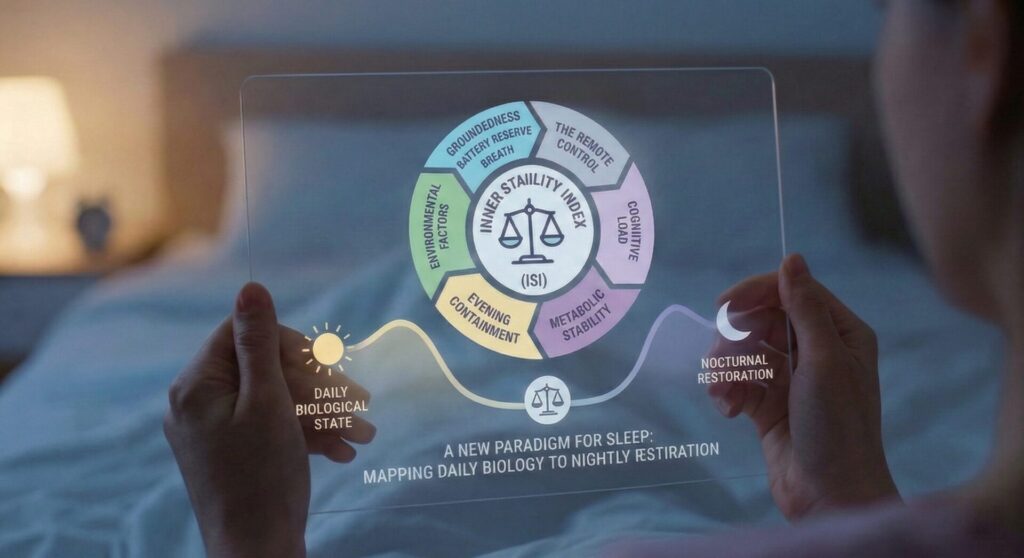
If you can’t switch off after work — if you regularly feel wired but exhausted, physically done but mentally still running — this is a nervous system pattern, not a sleep problem.
The Inner Stability Quiz identifies exactly which layer of your system is most unstable and what needs to be addressed first. It takes a few minutes and gives you a precise starting point — not generic advice, but a clear map of where your system is breaking down.
Take the Inner Stability Quiz →